
Indianapolis semi truck accident representation
Indianapolis Semi Truck Accident Lawyer
If a tractor-trailer crash left you seriously hurt, we can investigate what happened, protect you from insurer pressure, and pursue the compensation your recovery requires.
What an Indianapolis semi truck accident lawyer does for your claim
A semi truck collision is rarely a simple fender-bender. The injuries tend to be severe, the insurance coverage is layered, and the evidence can disappear quickly unless someone acts fast.
Working with an Indianapolis semi truck accident lawyer means you have a team focused on proving how and why the wreck happened and who is legally responsible. That includes preserving key evidence such as driver logs and onboard data, identifying all potentially liable parties, and documenting the full impact of your injuries.
Indiana Truck Accident Lawyer helps injured people and families after serious commercial-vehicle crashes. Our job is to take the claim off your shoulders, keep the process moving, and prepare the case as if it will go to trial, even if it ultimately resolves through settlement.
Because many Indianapolis truck crashes happen on high-traffic corridors like I-465, I-70, I-65, and near the interchanges around downtown, the fact pattern often includes merging conflicts, lane changes in heavy congestion, work zones, or multi-vehicle pileups. Those details can change fault, damages, and which insurance policies apply.
Early investigation matters in semi truck cases
In truck claims, the most valuable evidence is time-sensitive. Carriers and insurers move quickly to control the narrative, repair vehicles, and close files. Your side should move quickly too.
A thorough investigation may include:
- Preservation demands: Spoliation and preservation letters to the motor carrier and insurer to keep records intact.
- Electronic evidence: ELD hours-of-service logs and engine control module data covering speed, braking, and throttle events when available.
- Driver records: Qualification files, drug and alcohol testing records, training records, and safety history.
- Vehicle condition: Maintenance and inspection records involving brakes, tires, coupling systems, and cargo securement.
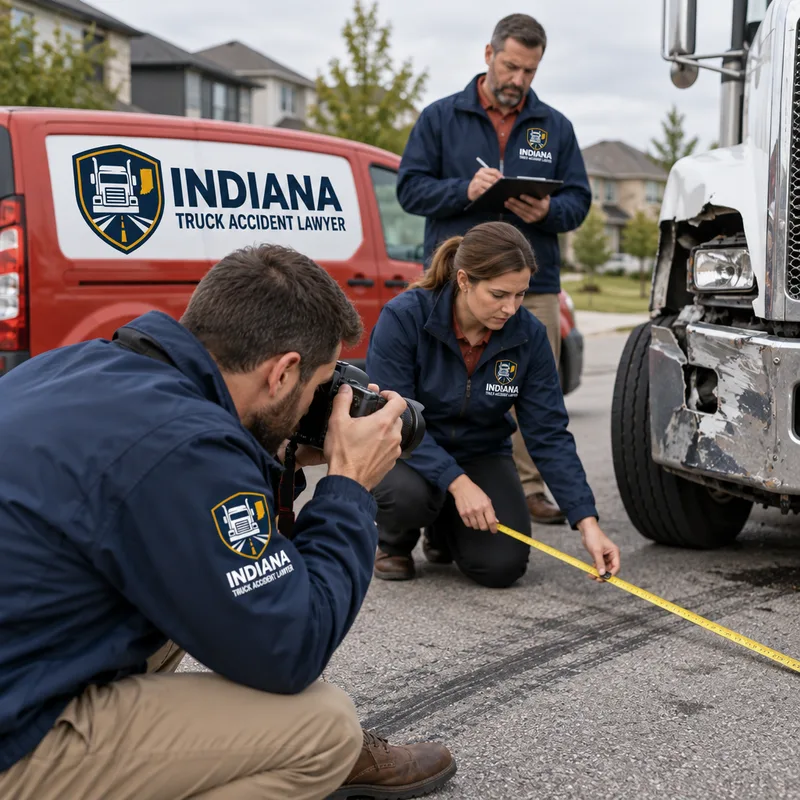
- Scene analysis: Vehicle damage, roadway evidence, dashcam footage, and nearby video.
In Indianapolis, interstate crashes often involve Indiana State Police, while Indianapolis Metropolitan Police Department handles many surface-street collisions. Obtaining the reports is only a start. The larger task is using the evidence to show negligence and connect it to your medical harm and financial losses.
A crash near a busy logistics area or freight route may also involve dispatch instructions, delivery deadlines, or loading decisions made far from the scene. Those details can expand the case beyond the driver alone.
Common causes of Indianapolis tractor-trailer crashes we look for
Driver fatigue and hours-of-service violations
We scrutinize ELD records and dispatch timelines for driving beyond legal limits, skipped rest breaks, or falsified logs.
Unsafe lane changes and blind-spot collisions
On multi-lane stretches like I-465 and I-70, sideswipes and squeeze crashes often hinge on visibility, signaling, and speed differentials.
Speeding and following too closely
A fully loaded tractor-trailer needs more distance to stop. Rear-end impacts frequently involve speed, inattention, or pressure to meet schedules.
Improper loading or cargo securement
Shifts in weight can cause jackknifes, rollovers, and lost cargo. Liability may extend to loaders, shippers, or contractors.
Mechanical failure and poor maintenance
Brake problems, tire blowouts, and lighting defects can point to negligent inspection or maintenance and open additional insurance coverage.
The claim process
How we handle a semi truck injury claim
-
01
Initial fact review and immediate protections
We gather what you have, identify urgent evidence risks, and advise you on what to avoid when insurers request recorded statements or broad medical releases.
-
02
Investigation and liability mapping
We build the fault picture using crash reports, witness outreach, video searches, data requests, and carrier records. We also identify responsible parties and applicable policies.
-
03
Medical and damages documentation
We document diagnosis, treatment, work restrictions, and future care needs so the claim reflects surgery, rehabilitation, or long-term limitations when applicable.
-
04
Claim strategy and negotiation
Once the evidence and damages are organized, we present a clear demand package and negotiate from a position supported by records rather than assumptions.
-
05
Litigation when needed
If filing suit becomes necessary, we manage deadlines, discovery, expert support, and court requirements while staying focused on liability and the full value of your losses.
Local jurisdiction context
Local experience that fits how Indianapolis truck wrecks happen
Truck crashes in Indianapolis often reflect how the city moves. Commuter surges on I-65 and I-70, heavy freight flow around industrial corridors, and frequent construction and lane shifts can turn a single mistake into a major collision.
Where the crash occurred shapes the evidence and possible defenses. A downtown wreck may have more video sources and witnesses than a late-night collision on a less populated stretch of I-465. A crash near the Indianapolis International Airport area may involve tight delivery schedules and multiple contracted parties.
If your case involves a fatality, we handle communication with the insurer and investigate the events leading to the death while your family focuses on immediate needs. A structured case review can clarify what information matters, what deadlines apply, and what the claim process can realistically look like.
Commercial vehicle cases require a wider search
Claims involving other commercial vehicles share some investigative steps with semi truck cases, but the proof and responsible parties can differ. Truck cases typically require deeper record requests and a broader liability analysis than ordinary car accident claims.
If you are getting medical care, missing work, or facing pressure to settle quickly, a focused legal review can clarify fault, next steps, and what your claim should include before anything is signed.
Call for a Free ConsultationPractical answers
Indianapolis semi truck accident claim FAQs
How long do I have to file a semi truck accident lawsuit in Indiana? +
In Indiana, many injury lawsuits must be filed within two years of the date of the crash, but exceptions and special notice rules can apply in certain situations. Because evidence in truck cases can be lost quickly, it is smart to have a lawyer review deadlines and preservation steps as early as possible.
Who can be held responsible in a tractor-trailer wreck besides the driver? +
Liability can extend beyond the driver to the motor carrier, an owner-operator's company, a maintenance provider, a shipper or loader, a broker, or a parts manufacturer. The right defendant list depends on what the investigation shows about hiring, training, supervision, dispatch pressure, loading, and mechanical condition.
What compensation can a semi truck accident lawyer pursue for me? +
A truck crash claim can include medical bills, future treatment needs, lost wages, reduced earning capacity, pain and suffering, and other crash-related losses supported by records. The value turns on injury severity, how long recovery takes, whether limitations persist, and what the evidence shows about fault.
Should I give the trucking company's insurance adjuster a recorded statement? +
You are generally not required to give the other side a recorded statement, and doing so can create problems if questions are leading or incomplete. It is usually safer to get legal guidance first so your information is provided accurately and does not undercut the claim.
What if I was partially at fault for the crash? +
You may still have a claim even if you share some fault, depending on how the facts apply under Indiana's comparative fault rules. Details such as lane position, following distance, and speed data can change the fault percentage and the ability to recover damages.
Do semi truck accident cases usually settle, or do they go to trial? +
Many cases resolve through settlement, but a fair settlement typically requires strong evidence, complete medical documentation, and a willingness to litigate if the insurer refuses to pay full value. A case prepared for trial is more likely to be taken seriously in negotiations.
I was hit by a commercial truck while working. Is this a workers' comp case or a lawsuit? +
It can be both: workers' compensation may cover medical care and wage benefits if you were working, while a separate third-party claim may exist against the truck driver or trucking company. Coordinating the two requires care because the benefits system and liability claim have different rules and timelines.
Free consultation
Talk through your Indianapolis semi truck accident case with a lawyer
Share what happened and where you are in treatment. We will explain what evidence to preserve, how fault is investigated in truck cases, and what a realistic path to compensation can look like.
Call for a Free Consultation